
So, what kind of trap are we talking about?
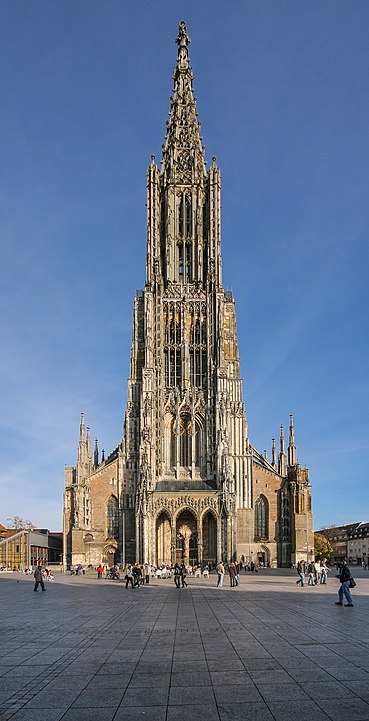
Let’s take the Ulm Cathedral in Germany as an example. Imagine this: first, you admired its tower soaring into the sky from the square below:
And then you ascended to the observation deck, from which the entire stone panopticon of the cathedral, all its gargoyles and chimeras clinging to the cornices, is perfectly visible:

And you’ve listened to my lectures on the Middle Ages! This means you’re seasoned in the art of interpreting images that remain elusive to the average tourist. You want to test your hermeneutic skills; the stone hieroglyphs awaiting an interpreter spur you on; you’re eager for the challenge.
And the main thing is, the task seems fairly simple! The first pair of images is explained effortlessly:

Before us are an elephant and a lion. And we remember well what the medieval bestiaries – books about animals and their properties – said about the elephant. The elephant is engaged in mortal rivalry with the huge snakes of India. The snake attacks the elephant by ambush and squeezes it with its coils; the elephant falls to the ground, and the snake ends up crushed:

To the medieval reader of the bestiary, the biblical parallel would immediately come to mind: “And the great dragon was cast out, that old serpent, called the Devil, and Satan, which deceiveth the whole world: he was cast out into the earth,”. Thus, the relentless battle between the elephant and the snake symbolically reminded of the eternal struggle between God and the Devil (and, of course, the inevitable victory of the former).
The lion is a bit more complicated. Sometimes, as a bloodthirsty predator, it could represent the Devil himself (as said in the epistle of Apostle Peter: “Be sober, be vigilant; because your adversary the devil, as a roaring lion, walketh about, seeking whom he may devour.”). But on the other hand, in its royal dignity, the lion is akin to Christ; and the famous phrase from the Book of Revelation – “Behold, the Lion of the tribe of Judah, the Root of David, hath prevailed to open the book, and to loose the seven seals thereof.” — theologians traditionally understood as a reference to Christ. Thus, the lion often appeared in a pious context; in the Strasbourg Cathedral, numerous lions guard the throne of the Virgin Mary:

So, the sculptures of Ulm Cathedral symbolically remind us of God, His power, and grace. Now let’s interpret the next pair of sculptures, taking just a second to think:

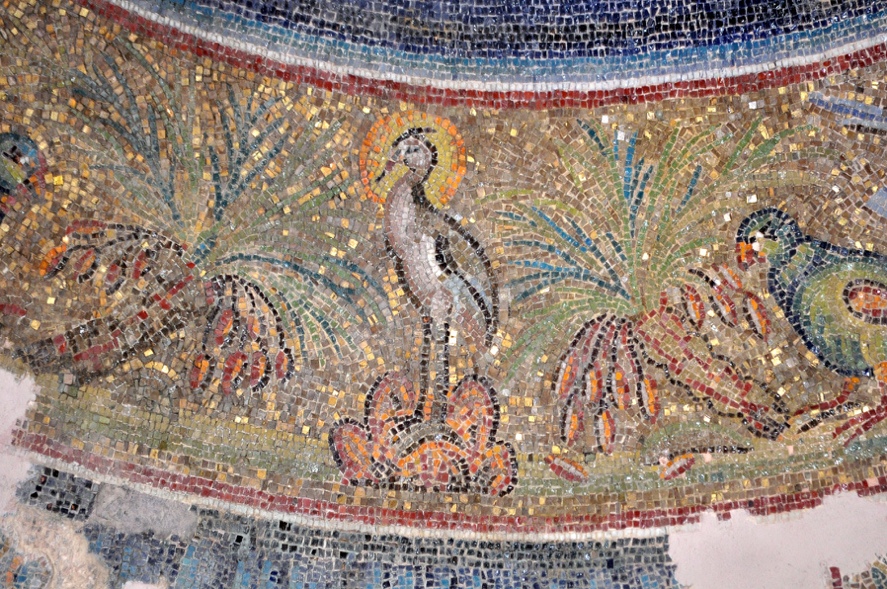
On the left – the Phoenix, a symbol of the resurrecting Christ. Christian artists had used the mythical bird in this sense before: for example, a mosaic from a church in Naples:
And on the right – a peacock, about which first Aristotle and later Blessed Augustine wrote that its flesh does not decay. Due to this property, the peacock also came to symbolize resurrection and eternal life. The earliest images of the peacock can be found in the Christian catacombs under Rome:

But not all sculptures can have a positive meaning! There must be some that are frightening, warning the faithful of dangers and temptations!
Such can be found too. For example, an owl and a bat:

The owl – not only a predatory bird but also a nocturnal one, intolerant of sunlight; and Christ himself said about Himself: “I am the light of the world; he who follows me shall not walk in darkness, but shall have the light of life.”
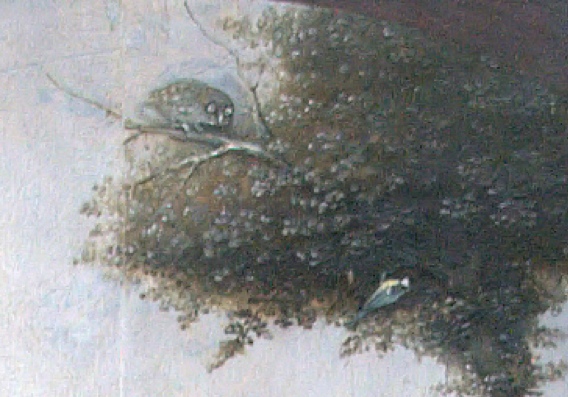
And so, the predatory owl (e.g., the Devil), ready to snatch up the Christian soul, is present in numerous paintings by Bosch:
And with the bat, also a nocturnal creature, they are two of a kind…
But wait! The bat is clearly modern, you can tell! So we can’t include it in our analysis: at least, we must first ensure that the original image looked the same. And if not? What if the original sculpture didn’t survive at all, and the bat is entirely at the discretion of a modern sculptor?
And then an even more disturbing suspicion creeps in: what if all the previous sculptures, so cleverly interpreted by us, also have nothing to do with the Middle Ages?
Alas, it is precisely the case. A little investigation shows that all images in Ulm Cathedral are modern. And they cunningly mislead us viewers, in a double sense. Firstly, they are artificially aged, so it’s hard to recognize the novelty. Secondly, they were made by people clearly educated in medieval symbolism. A medieval artist COULD depict a lion, and an owl, and a phoenix; but COULD and DID are two different things.
Here it is, the danger that lurks for us, curious and already well-informed art lovers, under the vaults of cathedrals. Before delving into the meaning of any intriguing element, any whimsical chimera or a stone creature perched on a cornice, we need to find out: what are we looking at? An original – or an element introduced by modern restorers?
If the latter, then it’s better not to try explaining it at all: otherwise, you might first give a modern fantasy a beautiful interpretation, and then use it when analyzing other details; from one false interpretation another will ensue, fantasy will be based on fantasy, and in the end, it will be such a mess that tales of medieval astronauts will pale in comparison…
Well, now you are warned. Be careful, do not let your imagination run wild. And listen to my lectures, of course; with them, you surely won’t make a blunder.
Also, I wonder: have you ever been to a real gothic cathedral? Which one? What impressed you the most?
Share your memories in the comments. I’ll start:
