
TACTIC ONE: SHOW UP, PROVIDE EXPLANATIONS – AND HOPE FOR THE BEST
Who reported Paolo Veronese, that remains a mystery. The patrons? Unlikely. As far as we know, the Dominican monks who needed a huge canvas for the refectory (which was, in simple terms, a large cafeteria for monks) of the Santissimi Giovanni e Paolo Church in Venice, were quite satisfied with the work.
But alas, among the citizens there are always vigilant ones, those with long noses and too much time on their hands; this breed, known in certain circles under the term “rats”, is inexterminable.
And so, three months after completing the massive painting depicting the Last Supper (a subject quite suitable for a refectory), Veronese was summoned for questioning.
And he showed up! Moreover, the transcript has been preserved, so we know well both the accusations made and the tactic chosen by the artist for his defense.
What did the inquisitors dislike about the painting?

The first, and most obvious, inquiry was about the discrepancy with the biblical description. Clearly, there could not have been servants, purebred dogs, nor a dwarf in a jester’s cap present at the Last Supper:

But even more questions from the defenders of the true faith were raised by these characters:
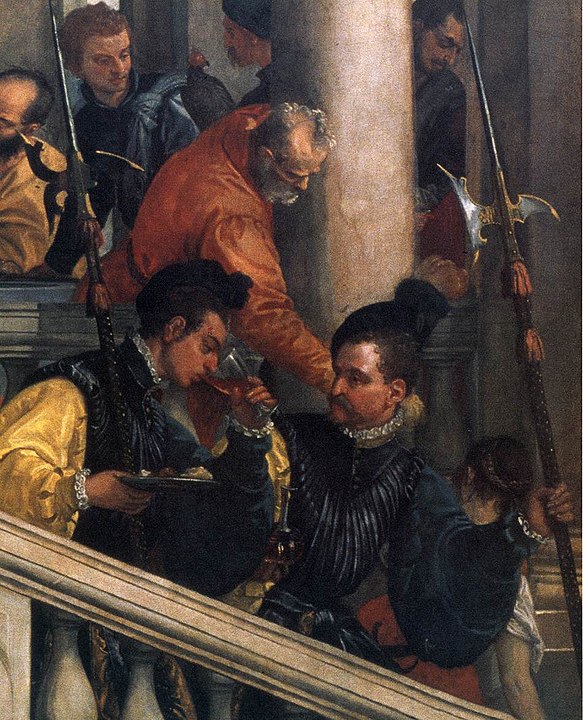
In the transcript, the accusers referred to them as “dressed in the German manner.” To understand the trap set for Veronese, one must place the events in historical context. The year is 1573; for fifty years, a real bacchanalia has been unfolding beyond the Alps: Luther, in heretical frenzy, is undermining the spiritual foundations of the Catholic faith! In many German principalities, those heretics have already triumphed. Could Veronese’s painting be seen as ideological sabotage? Is he conducting covert Lutheran propaganda?
The artist defended himself calmly and thoughtfully. He cited the example of Michelangelo, who adorned the Sistine Chapel with far more provocative figures; he explained that art has its own rules, and that an artist has the right to fill the empty spaces of a painting with figures as his imagination dictates; he assured them of his commitment to church doctrine; and finally, he reminded them that all artists are a bit mad, which should be considered an extenuating circumstance.
It’s unclear which argument ultimately prevailed; the important thing is that one did! The tribunal’s decision was surprisingly lenient: Veronese was required to eliminate all discrepancies between the painting and the biblical text within three months.
What Veronese did next must definitely be taught to young designers: it’s a masterclass in handling client!
Naturally, the artist did not want to rewrite the huge canvas. So he found another way to align the image with the biblical text: change the story! And thus, he added an inscription to the balustrade:
FECIT D COVI MAGNV. LEVI. – LEVI MADE GREAT FEAST FOR THE LORD
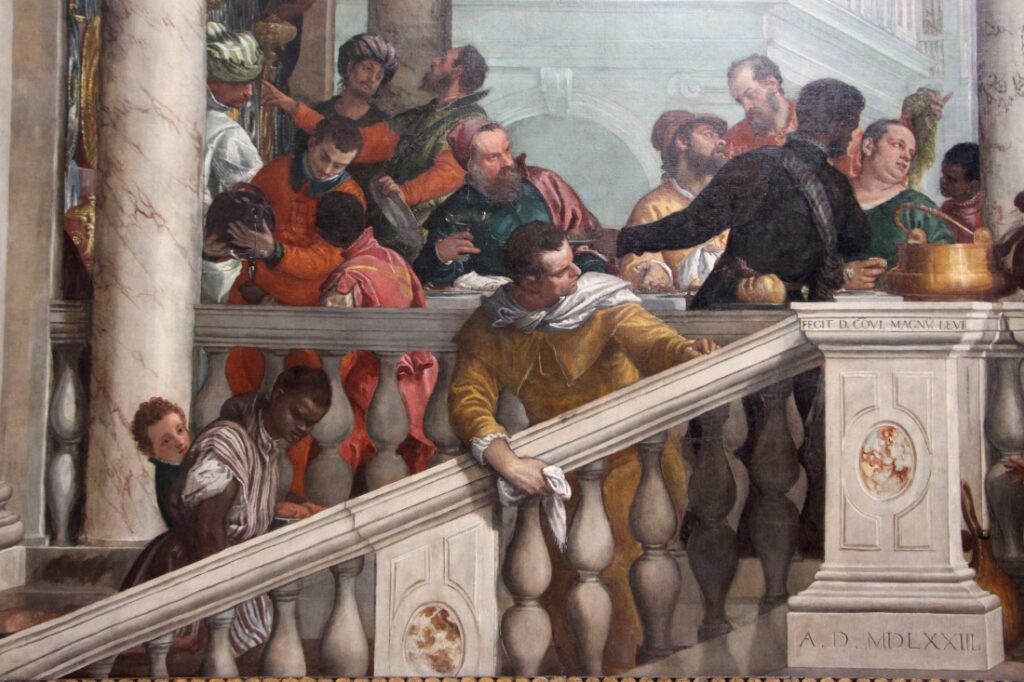
And on the second balustrade, he pointedly placed a reference to a biblical verse: LUKE, CHAPTER 5. As if to saying: “Misinterpret it now, I dare you!”
So, the painting no longer depicted the Last Supper, but rather the Feast at the House of Levi. The episode fits perfectly. Firstly, the very words “great feast” explained the numerous figures in the painting. Secondly, miraculously, jesters and Germans were now not just excusable, but necessary! For the Evangelist Luke says:
And Levi made him a great feast in his own house; and there was a great company of publicans and others that sat down with them. But the scribes and Pharisees murmured against his disciples, saying, Why do you eat and drink with publicans and sinners? And Jesus answering said unto them, They that are whole need not a physician; but they that are sick; I came not to call the righteous, but sinners to repentance. (Luke 5:29-32)
These words could always be cited if the Inquisition had further questions: saying, I depicted precisely the sinners from beyond the Alps. The painting and the text aligns perfectly, just as you insisted, your holiness.
It turns out that the standard set of naiveties and self-delusions – “it’s a mistake; I’ll explain everything; they’ll sort it out; they don’t put people in prison for such things!” – have worked in Veronese’s case. He has entrusted himself to the competent authorities, and they showed paternal moderation: they sorted out his motives, reproached indulgently – and let him go.
However, I still would not recommend taking Veronese as an example. At the very least, two other options should also be considered. And therefore…
TACTIC TWO: A DANGER FORSEEN IS HALF-AVOIDED
Think what you will, but I continue to insist: Rubens is a genius and a role model. Because while Veronese, experienced and wise, did not foresee problems with the inquisitors, young Rubens both anticipated and prevented them.
The year is 1605, Rubens is twenty-eight, and he is at the court of Duke of Mantua. The artist is favored and flush with commissions; the main one being a cycle of paintings for the Church of the Holy Trinity. The climax of the cycle is the appearance of the Trinity to the family of Duke Vincenzo Gonzaga. And it is with this scene that there is a particular challenge…
The issue is that sixty years prior to the events described, the Council of Trent issued several clarifications and instructions specifically to artists. Many plots not founded on biblical text were banned; painters were instructed to strictly follow the letter of the Scriptures and restrain their imagination, and patrons were advised to exhibit personal modesty. In particular, it was precisely defined who could be worthy of certain visions (yes, there was a whole classification developed). The Trinity, for example, could only appear to officially canonized saints.
Duke Gonzaga was nowhere near sainthood; but obviously, Rubens did not want to offend his patron. The solution he found proves that if Peter Paul had not become a great artist, he would have been no less a great bureaucrat. Because what he did was this:

The entire scene looks like a classic “apparition”: above is the Trinity, while below, the members of the Duke’s family reverently gaze upon it. But notice: the Trinity isn’t real! It’s merely depicted on a tapestry, unfurled in the sky by angels.
Thus, what we have here is a pseudo-vision. Even for the most meticulous inquisitor, there seems to be nothing offensive here. Compliance is maintained, and the patron is satisfied.
Overall, I like Rubens’ approach: it’s always better to prevent than to deal with consequences. But what if the damage is already done?
Then tactic number three comes into play. Namely…
HEY, WAIT A SECOND!
You know, that I used to live in Russia, right? It’s a tough country to live in, which is reflected in Russian proverbs. One of them goes: “Good things should come in small amounts”
Which is why I think it’s enough for today 🙂
However, if you’d like to hear the story of a third artis, escaping merciless jaws of inquisition – let me know in the comments, an I’ll write a post about it.